

Sacroiliac Joint Injection Specialists in Adrian, MI
If you are searching for experienced sacroiliac joint injection specialists in Adrian, MI, our board-certified doctors, Dr. Louis Bojrab, MD, FIPP, Dr. John Chatas, MD, FIPP, and Dr. Edward Washabaugh, MD, FIPP, at Michigan Pain Specialists, provide comprehensive, personalized treatments for chronic lower back and pelvic pain. By utilizing advanced fluoroscopic guidance, our dedicated medical team accurately delivers targeted anti-inflammatory medication directly into the sacroiliac joint to effectively reduce swelling and alleviate debilitating discomfort. For more information, contact us or request an appointment online. We are conveniently located at 770 Riverside Ave suite 207, Adrian, MI 49221.
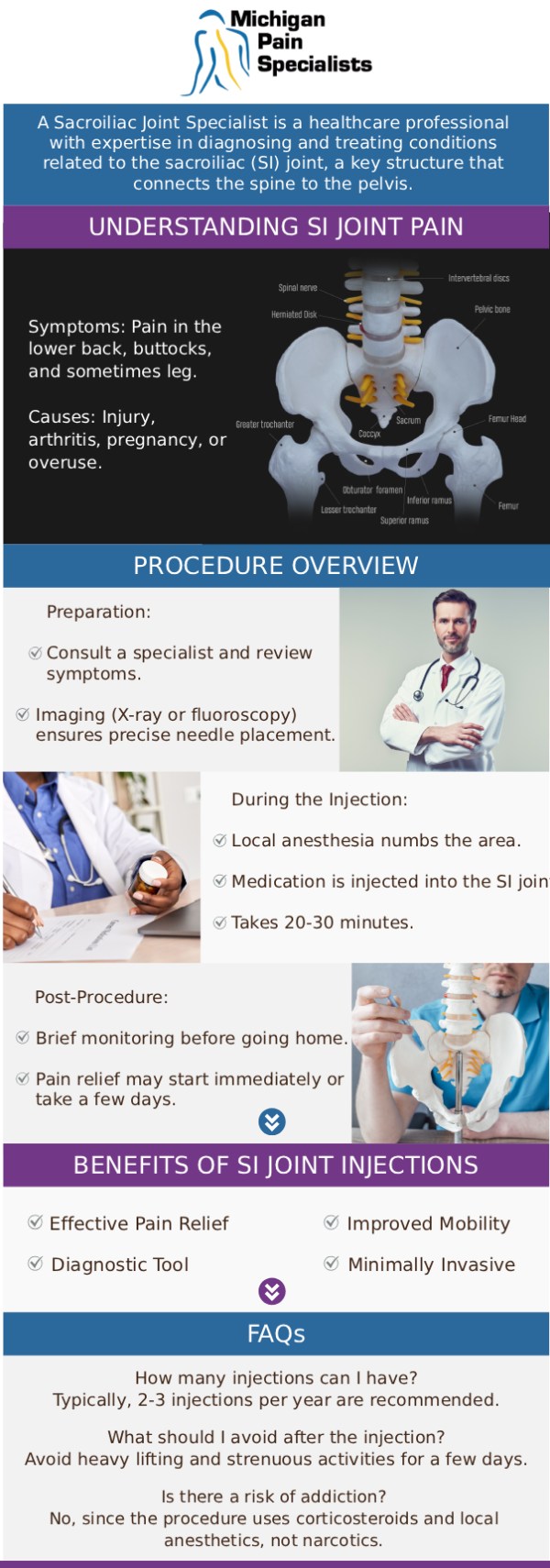
Table of Contents:
What is a sacroiliac joint injection, and how does it help with SI pain?
How long does pain relief last after a sacroiliac joint injection?
Who is a good candidate for sacroiliac joint injections?
What can I expect during a sacroiliac joint injection procedure at Michigan Pain Specialists?
At Michigan Pain Specialists, we are dedicated to providing advanced, effective solutions for patients suffering from chronic pain, including lower back and pelvic discomfort. One of the specialized procedures we offer at our clinic is the sacroiliac (SI) joint injection—a minimally invasive treatment designed to both diagnose and relieve pain stemming from the SI joint, where the spine meets the pelvis.
During your SI joint injection consultation, our experienced pain management physicians use state-of-the-art imaging guidance, such as fluoroscopy or ultrasound, to ensure the needle is precisely placed into the targeted joint. Once correctly positioned, a combination of local anesthetic and corticosteroid medication is delivered directly to the SI joint.
The local anesthetic provides immediate, temporary relief, helping both you and your provider confirm whether the SI joint is the true source of your pain. The corticosteroid works to reduce inflammation, often resulting in sustained pain relief and improved mobility for several weeks or even months.
At Michigan Pain Specialists, we typically recommend sacroiliac joint injections for patients who have not achieved adequate relief from conservative treatments such as physical therapy, medications, or lifestyle modifications. In addition to their therapeutic benefits, these injections serve as a valuable diagnostic tool. If you experience significant, immediate pain relief after the injection, it strongly indicates that your SI joint is the source of your symptoms, allowing us to tailor your ongoing treatment plan more effectively.
Most patients treated at Michigan Pain Specialists begin to notice pain relief within a few days of their sacroiliac joint injection. The local anesthetic offers early relief, while the corticosteroid medication works to reduce inflammation over time. For some, the benefits are felt almost immediately and can last for several days, while others may experience gradual improvement over about a week.
The duration of pain relief varies from person to person. On average, our patients typically experience significant relief for about two to three months. However, some may find their pain returns sooner, while others enjoy longer-lasting comfort. Factors such as the underlying cause of your SI joint pain, the degree of inflammation, your body’s unique response to steroids, and any additional health conditions can all influence how long your pain relief lasts.
If you experience notable pain relief from your initial injection, Michigan Pain Specialists may recommend repeating the procedure when necessary. Our physicians are careful to space out injections appropriately to minimize the risk of side effects from corticosteroids and to ensure the safest, most effective care.
Every patient is different, and your experience with SI joint injections will be uniquely yours. We encourage you to discuss your results and expectations with your Michigan Pain Specialists provider. Together, we can develop a treatment plan tailored to your individual needs and help you achieve the best possible outcome.
At Michigan Pain Specialists, we offer sacroiliac (SI) joint injections as an option for patients experiencing persistent lower back, buttock, or upper leg pain suspected to originate from the SI joint. This minimally invasive procedure may be recommended when conservative treatments—such as physical therapy, oral medications, or activity modification—have not provided adequate relief. Patients who notice their pain worsening during activities like standing, walking, climbing stairs, or moving from sitting to standing may benefit from this intervention.
Our team at Michigan Pain Specialists carefully evaluates each patient to determine whether the SI joint is the true source of pain. This comprehensive assessment includes a detailed medical history, a thorough physical examination, and, when appropriate, imaging studies to rule out other potential causes such as lumbar spine or hip conditions. In some cases, specific diagnostic maneuvers or a positive response to a prior diagnostic SI joint injection can further confirm the diagnosis.
While SI joint injections are safe and effective for many, they may not be suitable for everyone. Patients who are pregnant, have active infections, uncontrolled bleeding disorders, or allergies to medications used in the procedure may not be candidates. At Michigan Pain Specialists, our experienced providers will work closely with you to determine if this treatment aligns with your symptoms, medical history, and overall goals for pain relief.
At Michigan Pain Specialists, our board-certified doctors, Dr. Louis Bojrab, MD, FIPP, Dr. John Chatas, MD, FIPP, and Dr. Edward Washabaugh, MD, FIPP, are dedicated to providing safe, effective, and patient-centered care for those suffering from lower back and pelvic pain. If you are scheduled for a sacroiliac (SI) joint injection with us, here’s what you can expect during your visit:
● Personalized Welcome and Preparation
Upon arrival at Michigan Pain Specialists, you will be greeted by our friendly clinical team. We’ll take time to review your medical history and answer any questions you have about the SI joint injection. Our goal is to make you feel comfortable and informed every step of the way.
● Procedure Room Experience
You will be brought into one of our state-of-the-art procedure rooms, where you’ll lie comfortably on your stomach. The injection area—your lower back and upper buttock—will be cleansed with an antiseptic solution to prevent infection. Before proceeding, we will numb the area with a local anesthetic to minimize any discomfort.
● Targeted Pain Relief
Once proper needle placement is verified, your physician will inject a combination of local anesthetic and steroid medication directly into the SI joint. The anesthetic offers immediate, short-term pain relief, while the steroid works to reduce inflammation for longer-lasting results.
● Aftercare and Follow-Up
The procedure typically takes 15 to 30 minutes. Afterward, you’ll be monitored briefly by our staff to ensure your safety and comfort. Most patients can return home the same day and resume light activities, although we recommend avoiding strenuous activity for 24 hours. Some patients notice immediate relief from the local anesthetic, while the full benefit of the steroid may take several days.
The team at Michigan Pain Specialists will provide you with clear aftercare instructions and will schedule any necessary follow-ups to track your progress and discuss further treatment options if needed. For more information, contact us or request an appointment online. We are conveniently located at 770 Riverside Ave suite 207, Adrian, MI 49221. We serve patients from Adrian MI, Tecumseh MI, Blissfield MI, Britton MI, and surrounding areas.
Check Out Our 5 Star Reviews



Additional Services You May Need
▸ Epidural Steroid Injections
▸ Spinal Cord Stimulation
▸ Rhizotomy Ablations of the Spine
▸ Intracept
▸ Sacroiliac Joint Pain
▸ Diabetic Neuropathy
▸ Cancer Pain
▸ Cervical Radiculopathy
▸ Lumbar Radiculopathy (Sciatica)
▸ Spinal Stenosis
▸ Spondylolisthesis
▸ Facet Joint Syndrome
▸ Spinal Compression Fractures
▸ RSD (Complex Regional Pain Syndrome)
▸ Coccydynia (Tailbone Pain)


 Send Text
 How May I Help You?